

Overview
A modular trading automation system with strategy evaluation, machine-learning signal filtering, and rule-enforced risk controls.
The challenge
Turning market signals into automated trades requires far more than computing an indicator. The system must coordinate market data, strategy evaluation, capital constraints, order submission, position monitoring, and restart recovery without letting a failed component bypass the risk model.
What I built
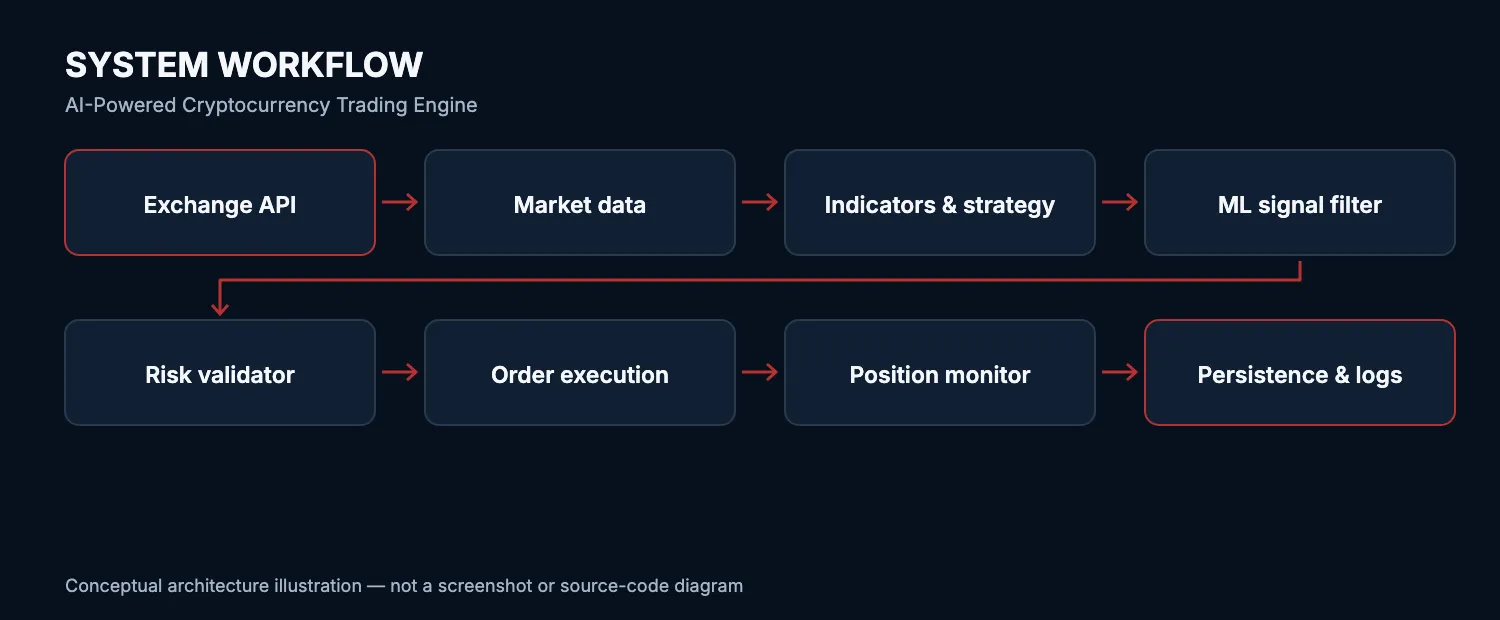
I built and delivered a Python trading system for the Tabdeal exchange. Its components separate market synchronization, indicator calculation, strategy decisions, ML confidence scoring, pre-trade safeguards, execution, state persistence, and observability. The documented implementation supports simulation and live-operation modes.
My role
Python engineering, exchange API integration, strategy and risk workflow, modular architecture, delivery documentation.
Key capabilities
- Evaluates five instrument pairs in the documented configuration: TON/USDT, ETH/USDT, BTC/USDT, NOT/USDT, and DOGE/USDT.
- Uses EMA, RSI, ADX, ATR, and CCI as part of technical signal analysis.
- Applies an ML confidence filter before candidate signals progress to execution; the documented threshold is 52%, with retraining after 20 closed trades.
- Coordinates wallet checks, position sizing, order placement, automated take-profit and stop-loss levels, and open-position monitoring.
- Enforces exposure and daily trading limits through a dedicated risk and pre-trade validation layer.
- Persists open positions and trading state to support restart recovery and detailed logging.
Engineering approach
Data & indicators
A dedicated data layer connects to the exchange REST API, while indicator and strategy modules transform price/trade inputs into evaluated candidate signals.
Signal filtering
The strategy decision and ML confidence score are kept as separate steps so low-confidence candidates can be rejected before the execution path.
Risk boundaries
Risk checks and pre-trade validation consider position limits, daily profit/loss thresholds, wallet availability, and order sizing before a trade is sent.
Execution & resilience
The execution and monitoring modules coordinate order and position lifecycle events. State management, persistence, and logs help resume safely after an interruption.
Architecture
Documented configuration
These are documented configuration values, not performance or profitability results.
- 5 market pairs
- 30-second market scan
- 15-second position check
- 1x–3x configured leverage
- Maximum 2 open trades
- Daily +1.0% / −0.5% stop thresholds
Outcome
Delivered a modular automation workflow to a freelance client, with documented setup, simulation/live configuration, risk constraints, and system components. This case study describes the architecture and implementation—not investment performance or profitability.