

Overview
An isolated hands-on environment for reproducing web vulnerability classes and tracing authentication and authorization behavior.
The challenge
Understanding web vulnerabilities requires seeing how HTTP requests, sessions, application state, and server-side validation interact. A controlled lab makes those relationships observable without testing unauthorized production systems.
What I built
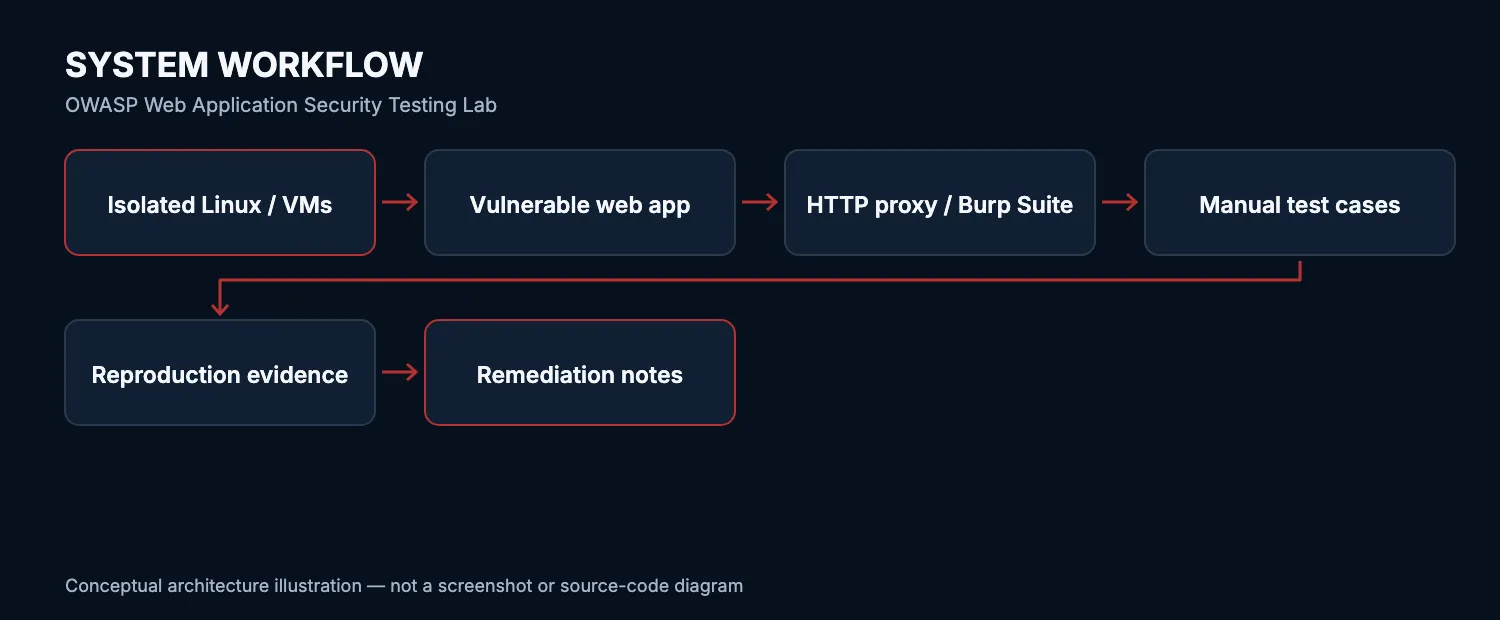
I assembled a Linux/virtual-machine-based practice environment around intentionally vulnerable web application behavior, including PHP- and MariaDB-backed components. I used Burp Suite and manual browser testing to inspect and replay requests, trace application flows, and evaluate vulnerability conditions across common OWASP categories.
My role
Lab assembly, vulnerable-flow investigation, HTTP traffic analysis, manual testing, issue reproduction and remediation reasoning.
Key capabilities
- Isolated virtual-machine or Linux-based web application testing environment.
- Practice with PHP/MariaDB-backed application behavior and session-aware request flows.
- Manual authentication and authorization testing, including access-control assumptions and session handling.
- Input validation and reflected/stored XSS exercises in controlled contexts.
- File-upload validation and application data-flow exercises.
- HTTP interception, request modification, replay, and analysis with Burp Suite.
Engineering approach
Environment
Virtualized and Linux-based test systems keep deliberately vulnerable components separate from production services.
HTTP workflow mapping
Requests and responses are captured to understand session state, application routing, and relevant authorization checks.
Controlled reproduction
Inputs and application behavior are tested to reproduce vulnerability classes and their prerequisites without relying on a live third-party target.
Defensive learning
Each exercise is connected to the missing validation or authorization control and the remediation pattern that would prevent it.
Architecture
Documented configuration
- Controlled lab, not a public target
- PHP/MariaDB-backed application exercises
- OWASP-aligned web security scenarios
Outcome
Established a repeatable practice environment for reasoning about request/response behavior, authentication, authorization, and common web security weaknesses.